The Hero's Journey of a Student: From the Classroom to the AI Tutor

In the last few years a lot of learning moved from physical classrooms to online ones. Research shifted too, with advances being accelerated by AI. For three decades AI in Education (AIED) stayed a small field, never more than 50 articles a year. Then it took off: by mid-2022, before ChatGPT, a 2024 review counted 2,223 articles in all[1], more than half of them published after 2016. I predict students are next: the next big shift will be to working mostly one-on-one with AI tutors.
Short on time? Read this post in or .
I have been teaching applied machine learning in an online graduate program at UC Berkeley for the past seven years.* I have run a classroom and watched how it operates, the good and the bad. More recently, I launched Uriversity with its first course in applied machine learning. Uriversity is developed with the help of AI, and its AI Teaching Assistant (AI TA) plays a major part in how we teach. Throughout this post I will compare the classroom to one-on-one work with an AI tutor.
At some point I noticed that the structure for this comparison falls fairly neatly around the hero's journey. It is the shape of Star Wars: a hero leaves the world they know, meets a mentor, is tested and comes back changed. The hero in this blog post will be the student. The classic hero's journey has twelve stages (going by Christopher Vogler's version). I will mark each one as we get to it. Let's go :)!
The student leaves the classroom to pursue one-on-one work with an AI tutor. What will they gain? What will they lose? And what can we salvage?
The classroom
I often feel one of the best things I can do in class is ask the class a question, ideally the "right" question, and on rare occasions call on a specific student (Stage 2 · Call to adventure). The Socratic method. I try to ask questions that highlight common misunderstandings or ones that will lead the students to a deeper level of understanding after they've wrestled with the questions for a bit. Most students don't raise their hands (Stage 3 · Refusal of the call).
Eventually one student takes the question and works it through with me. That's great. That's one student, in your classroom of maybe 20-40 students, that wrestled and interacted with the question. The other 39? Maybe they heard the question, maybe they thought about it and possibly got it in the end. But their level of engagement with the question isn't likely to match that of the student interacting with the teacher directly. Education researchers have a framework for how different modes of engagement affect learning: Interactive, Constructive, Active and Passive, or ICAP[2]. The paper describes exactly this situation: "For the majority of students who are silently listening to the discussion, the activity is passive."
Every student is challenged, in private
Getting students engaged in the classroom is hard. It's a different skill from teaching. I work hard to engage my students in the classroom, using quizzes, open questions, discussions and even sharing news. I do ok, but it's still hard work.
When students are asked a question, or even when they just fear they might be asked one, they pay attention. It forces that student, at that particular moment and on that one topic, to actually think and give it a try, and that adds value even if they end up being wrong. I believe that process reshapes the mental models inside their head and helps them understand things better. One research paper examined a related phenomenon. College students who tried to answer questions before reading an essay, and failed, later remembered the answers to those questions better than students who spent that time studying the essay. The advantage was still there a week later. Researchers call it the pretesting effect[3]:
GainWhat AI can give us that humans can't is this type of interaction with all students (Stage 5 · Crossing the First Threshold). First, AI finally makes it possible to work with every student at scale, both in terms of cost and in terms of feasibility. Second, we can continue until the student "gets it". Third, they don't have to do it publicly in front of all their peers, fearing getting the answer wrong or embarrassing themselves. Fourth, they can do it on their own time and at their own pace. They take the question, think it through, try something, hear the pushback from their AI TA and work it out until they get it. This way, when they do get to the next lesson, it will build on a solid foundation.
An AI can challenge every student directly with a question designed specifically for them, do so in private, and continue working with each one of them until they truly get it.
Learning alongside your fellow humans
Gain There's another surprising difference between speaking with a human professor and an AI TA. Students may be more comfortable asking the AI TA basic questions rather than exposing their confusion to the human teacher. There is related research, from health-related interviews with adults. In one experiment[4], people who believed they were talking to a computer and not to a human reported less fear of opening up. In a graduate AI programming course with 472 students[5], 58 percent said they had held back from asking a human instructor a question, out of discomfort, fear of being a burden, or worry that the question might seem silly. Those students were the ones more comfortable asking the course's AI teaching assistant, and they used it more than their classmates did. So students may be more vulnerable and open about what they don't know, and continue working with it until they actually get it.
On the other hand, one positive aspect of the classroom, one we wouldn't want to lose, is hearing other people's questions. Students are often shy and avoid openly asking about what they didn't understand. So when a professor is finally asked a question, there is a good chance that other students also had the same one, and they ended up staying silent and confused. Surprisingly, that's actually the good case! Because the dreaded bad scenario is the absolute silence after you finish explaining a complex topic. In that case, you know you likely lost the whole class.
Loss Working one-on-one with an AI TA, students potentially miss out on hearing other students' questions, and that would be a shame.
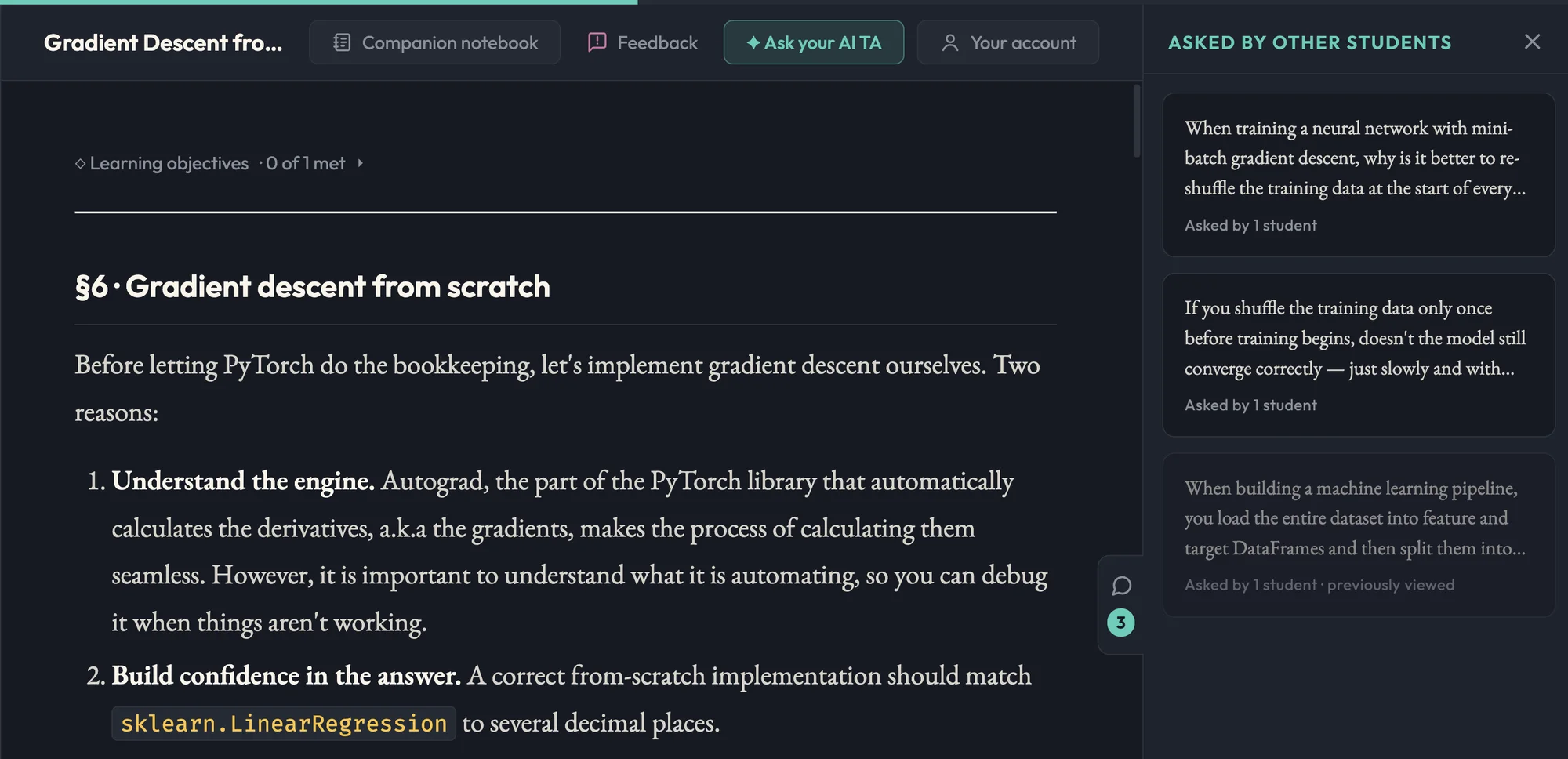
Salvaged That side of the classroom can be salvaged. The AI can identify good questions, anonymize them, detach them from any related context of the conversation in which they came up, and finally surface those as "Good Questions"! That's what we did at Uriversity: the Good Questions side panel shows anonymized good questions from other students.
Loss The human experience: There is one thing that happens in the classroom that we must remember to celebrate and preserve, possibly in different ways. Being in the same room with your fellow humans, going through a shared experience, developing friendships and developing human social and communication skills. I think it is going to be way too easy to miss out on this and we should make sure we purposely design opportunities for this to happen. In the online master's program where I teach, students travel to campus to meet each other and their professors in person. I think this is a valuable part of the program and we need to make sure we have this type of element in the future.
Loss Many voices become one: Over a degree you learn from a dozen teachers, and each one explains, writes and codes in their own way. With an AI tutor, every course speaks in one voice. If you've used AI for anything, whether it is writing code, writing text or even designing a user interface, you might have noticed that the AI has a specific "style" about it. If it's UI, you might have gotten a dark site with amber highlights. If your AI wrote text for you, it might have used the words "shape", "load-bearing" or just used the em dash a lot. The same seems to be true for code. In one study[6], a classifier trained on code written by one open AI model could tell it from human-written code about 84 percent of the time, across ten programming languages.
One interesting aspect of this and of humanity talking possibly more with their AI than with their family and friends, is that it could end up changing our own speech and style. There is already early evidence[7]: after ChatGPT was released, the words it favors, like "delve", started showing up more often in unscripted podcast conversations. This specific usage went back down, possibly due to a new release of ChatGPT or a growing awareness of the phenomenon. Other words like "meticulous" and "showcase" did sustain their increased usage. They say you are the average of the five people you spend the most time with. If four of the five are AI, that can affect the way you speak, think and act.
All that to say, and to bring attention (no pun intended) to the idea: if AI teaches us to write, whether it be code or essays, we and our children could learn this "alien" style. Is this... bad? I don't think so necessarily. But the variety of voices and perspectives is something we lose, and it is definitely something to keep in mind.
Teaching at the student's pace using the right tools for each topic
Teaching format: A common belief in education is that every student has a "learning style" that is most effective for them. For example, a student might say something like "I'm a visual learner". That idea has been researched extensively.
A 2025 review looked at 17 meta-analyses of learning styles. In the four that tested the idea directly, covering 143 studies, matching the teaching to a student's preferred style made almost no difference (an effect size of 0.04). As the review put it, "Learning style theories have appeal but, relying on them oversimplifies the intricacies of how students learn."[8] What we can do is fit the teaching format to the lesson being taught. As an earlier review put it, "the optimal curriculum for a writing course probably includes a heavy verbal emphasis, whereas the most efficient and effective method of teaching geometry obviously requires visual–spatial materials."[9]
So, when explaining an algorithm (say, sorting a list in alphabetical order), I can describe it in words, show the source code, or play an animation of it running. Each one shows something the others don't: the words give the idea, the code says exactly how, and the animation shows it happening.
In words
Walk down the list and compare each word with the one right after it. If the two are out of order, swap them. When you reach the end, the last word in the alphabet has sunk to the bottom, and it stays there. Walk the list again, stopping one word earlier each time, until there is nothing left to compare.
In code
def bubble_sort(a):
    for end in range(len(a) - 1, 0, -1):
        for i in range(end):
            if a[i] > a[i + 1]:
                a[i], a[i + 1] = a[i + 1], a[i]
    return a
In motion
Animation: the list Pear, Fig, Kiwi, Apple, Lime is sorted into alphabetical order by repeatedly swapping neighboring words that are out of order.
In a classroom setting you can prepare teaching material for each topic ahead of time, or write and draw something on the fly. This is what inspired us to let our AI TA choose between additional methods of explanation (e.g. code, charts and quizzes), based on the ideas it is trying to explain as well as the student's questions! We introduced this feature back in March 2026 and we call it the SideShow. The AI TA decides when a teaching aid would be beneficial and which one to use, then produces it on the fly.
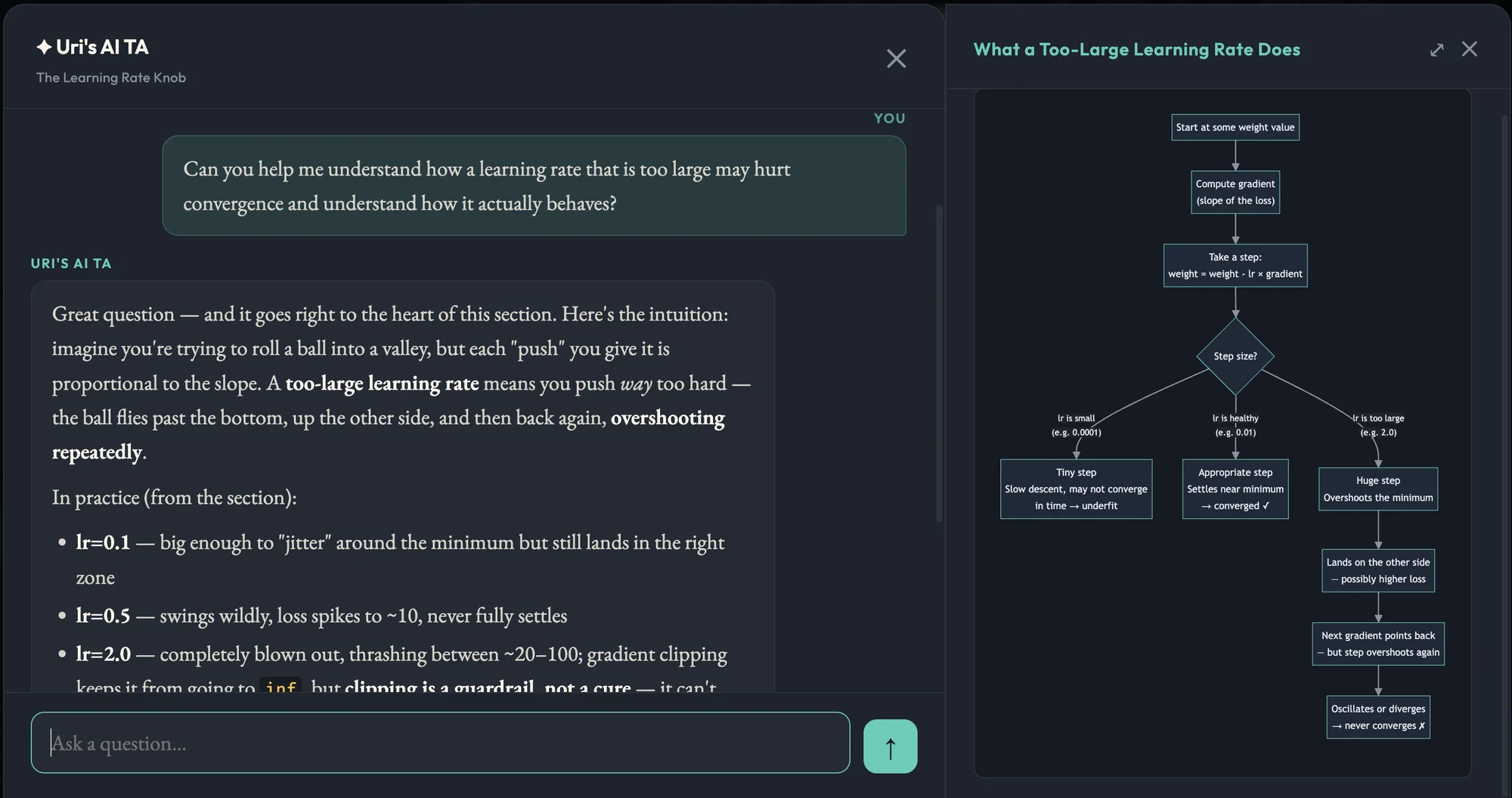
Teaching pace: Another aspect of the classroom dynamic is that even if the students try to keep up and keep focused, you will likely lose some students along the way. It is almost inevitable when teaching an advanced topic. Backtracking and addressing each student's individual confusion is just not possible in the classroom setting.
GainSoftware that works through a problem with each student, one step at a time, is the oldest attempt at this, and one of the better-studied kinds of adaptive teaching. Across 50 controlled studies it raised test scores by a median of 0.66 standard deviations over conventional instruction[10], roughly the difference between the 50th percentile and the 75th. The gain was much larger on tests written for the course (0.73) than on standardized tests (0.13). Those systems predate today's AI.
For today's AI, the clearest evidence is a 2023 randomized trial in a Harvard physics course (194 students) that compared a carefully designed AI tutor with an active-learning class[11]. The median learning gain with the AI tutor was more than double that of the class. Pace is where the two differed. The class took 60 minutes for everyone. With the tutor, 70 percent of the students took less than that and 30 percent took more. The few students who had found the class too fast all took longer than the median of 49 minutes, and the few who had found it too slow all took less.
The design of the tutor matters. In a randomized trial with nearly 1,000 high school math students[12], students who practiced with plain GPT-4 did 17 percent worse on the exam that followed (where AI was disallowed) than students who never had it. Students whose AI tutor was built to give hints rather than answers didn't do worse, but they didn't do better either. The authors' own explanation for not doing even better is that their tutor "remains passive, responding to students when they ask questions but failing to proactively engage students with the material."
So the research does not say that adding AI improves learning. A tutor that hands over answers made things worse. One that waited to be asked changed nothing. One built around the lesson, which let each student take the time they needed, did better than a good class.
LossOne thing we potentially lose with this flexibility is the help a scheduled class gives you in getting yourself to sit down and study. It is notoriously difficult to find the discipline or develop the habit of dedicating time to work that requires this kind of effort. Having a set time every week where you "have to" show up and study helps a lot.
Salvaged At Uriversity we kept part of this: the cohort has a schedule and weekly meetings. But it is only part of the picture. Students hand in their work whenever they are done, we don't hand out grades, and nobody flunks out. Our weekly discussions are meant to be an evolution of office hours, which in my experience all but died at the university once students could ask an AI. The discussions are not mandatory. About a third of the cohort came to each one, where my university office hours these days usually draw one student or none. The freedom I like most about students working at their own pace with an AI tutor is the same freedom that takes the deadline away.
Quizzes and exercises
Quizzes are one of the main ways students learn, both in a classroom and with an AI tutor. In the classroom, I start each lesson with a quiz. The quiz holds some of the value of open-ended questions in class, but it is usually a few multiple-choice questions instead. Its purpose is to make the student aware of things they haven't completely understood in the assigned material. On my end, it serves to test what the class understood and guide me to discuss further the ideas that weren't as clear.
Gain On the AI side, our quizzes start with an open-ended question which leads to an extensive conversation with the AI TA. The conversation continues until the AI TA is happy. I believe there is a great difference between choosing one of four answers to a question and holding a good-length conversation, answering open-ended questions, describing a concept in your own words and answering any follow-up questions. Not only is it harder to "game" the open-ended quiz, the interaction uncovers points where the student isn't clear or confident, and those issues can be clarified and explained.
Quizzing is one of the best-supported ways to learn. A review of 222 classroom studies with more than 48,000 students[13] found that quizzing raises achievement by about half a standard deviation. In a classic experiment[14], students remembered more of a short passage a week later when they had been tested on it, by writing down everything they could recall, than when they had spent the same time rereading it (56 percent against 42). Rereading came out slightly ahead only on a test five minutes afterwards. Whether the format of the quiz matters is less settled. In the classroom studies above, quizzes that asked students to recall the answer helped about as much as quizzes that asked them to recognize it. When a quiz came with feedback, having to come up with the answer yourself led to the best results on a test three days later[15], though its lead over multiple choice was clear on only one of the two final tests. Without feedback, multiple choice did better.
Exercises are another opportunity to use AI in this way. A typical exercise in the university would involve implementing some code and answering some questions. The evaluation process is usually a fairly simple rubric, a set of simplistic checks that allow quick and fair grading, and more often than not, you have one chance to submit your work.
Gain We can do better using AI. I want to be able to discuss with the student their approach to solving the exercise, even before they start working on it: asking about the decisions they made, options they considered and why they chose a specific approach. If a student gets stuck halfway through the exercise, I would like to allow them to submit their partial work and have them chat with the AI TA to work things out. Once they are finished, a final discussion with the AI TA would allow them to make sure they got it right and that they understood everything correctly. All this is what we have implemented today at Uriversity. The work left is to tweak our AI TA to offer further points of improvement on anything from coding to writing.
A final note on our end game. In the university setting the goal seems to be to give students a grade, fairly and efficiently: rubrics are simple and you typically can't keep submitting till you get it right. I personally don't care how long an exercise took you. I don't care if you submitted it once or five times. I care that we worked with you until you got it. We want to give the students that opportunity.
Getting it
I go through a chapter myself before it opens to the students, reading the content and working through the quizzes, and this still takes time. So when contemplating what is the "reward" step of the journey, I immediately thought of the little check mark that appears after your AI TA is satisfied: done. When I finally get that checkmark, personally, that makes me very happy :)! And by the way, it happens quietly, without a lot of fanfare. The idea: you can keep chatting with the AI TA if you want to explore the discussion further. I experience the same type of joy when completing an exercise, which works in much the same way.
A project of your own
Learning from group projects can be limiting. The applied machine learning university course that I teach ends with a group project. I personally find that group projects often lead students to experience a narrow part of what was taught in the course. If the course covered several techniques (say, exploratory data analysis (EDA) and implementing neural networks), a typical group would divide the different parts of the project (e.g. one student focuses on the EDA phase or god forbid just preparing the presentation), resulting in each student experiencing a small part of the actual complete picture.
Individuals may put in less effort as part of a group. What I found in my experience both as a student and as a teacher is that groups, and in particular large groups, often result in several team members contributing much less. That behavior may be related to a phenomenon psychologists call social loafing: people put in less effort as part of a group than on their own. In a survey of 420 university students about their own group projects[16], students reported more loafing on bigger projects and in larger groups, and less when teammates evaluated each other more than once along the way. A meta-analysis of 78 mostly laboratory studies[17] points at the same cure: when each person's contribution could be identified and evaluated, the loafing all but disappeared.
Evaluating each student's contribution and whether each student contributed equally can be challenging. A common practice is to hold surveys asking each team member about their contribution and their peers' contribution. The study above suggests they help. In my experience the answers are still influenced by politics, reciprocity and the popularity of the students. Quantifying each person's contribution from the actual work done can be hard as well. As a result, it may be challenging for the teachers and graders to verify that each student contributed "enough", whatever that means.
Loss So why do we have group projects in education? One potential benefit of group projects is learning from others, which can be very rewarding for both sides. Another reason often given is the importance of gaining practice in working as part of a team. I can't argue with that. I believe it's important to learn to work effectively with others, developing effective communication skills, leadership abilities and collaboration skills. Switching to individual projects will lose these aspects of project work.
The final reason to prefer group projects is a more practical one. One instructor, even with the help of a TA, would not have time to check 20 separate projects, certainly not at the level I would like. Teachers simply don't scale that far.
Gain But AI can! AI can go through all 20 projects. It can give you feedback at the coding level, at the essay or report level and at the specific subject's level (e.g. is your machine learning implementation solid). It can do it thoroughly and it can do it frequently. This will let every student do a project of their own, evaluated on what they applied from the course and individually accountable for the work. Note that we are just working out the design now.
Thesis or capstone project
In the master's program where I teach, every student takes part in a group capstone project. Part of the significance of this final course is proving to yourself and demonstrating to others the great progress you have made, the new skills you acquired, and that you indeed are a master of this field.
In the final stages of getting a PhD, you typically write a final thesis. That is a lot of work, but by that point you likely have published a few papers (depending on your field of study). By then, putting together the work you have done and presenting it as a cohesive story is within reach. The final step is literally defending your thesis, standing in front of a committee of distinguished professors that kindly agreed to read your thesis, and answering any questions they present to you: why you did this, why you didn't do that, and whether you considered another technique. It is scary :)! But that is what you need to do to get a PhD.
Gain An AI TA can challenge every student with this kind of questioning, not only the ones who make it to a PhD defense. Adding this type of final milestone is certainly on our roadmap.
Career growth
One of the satisfying things for me as a teacher is meeting my students in person. Often they tell me how the UC Berkeley degree, and occasionally my course there, helped them get a new position or job. Other times, even before they finished the course, they tell me how they already applied what they learned. That is a great motivator for me to keep trying and keep working on improving my teaching skills and making the course itself better.
What enabled them to get a new job, a new position or a promotion? You can argue it is the Berkeley degree and name and I believe that is definitely part of it. You can argue it is the new set of skills they acquired, the experience they gained working on problems, and I believe that's a part of it as well. It is all of that, as well as proving to yourself what you can do and, as a result, seeing yourself in a different light. That also changes how others see you and treat you. At least that's what I think. And if teaching with AI tutors proves more effective, I expect the prestige to follow with time, and universities to adopt these methods themselves.
I have some ideas on how to facilitate the process of getting a job once your studies are complete. But we'll leave that for a different post.
So what have we learned?
The student who leaves the classroom gains a mentor that asks them every question, in private and at their own pace, and stays with them until they get it. They lose the room: other students' questions, the hour set on the calendar that makes them show up, and the people sitting next to them. Some of that we already rebuilt, like the Good Questions panel. What's still missing won't come back by itself. We will have to design for it.
Often when embracing a new technology or a new form factor, we start the design from a blank slate. Anything is possible, and that is exciting and has a lot of potential. At the same time, it is worthwhile to examine what was lost and see if we can salvage the good stuff.
Join the experiment and the founding cohort
Uriversity's first cohort started November 2nd but you can still join and catch up until December 7th. If you're accepted, a seat on the founding cohort is free. The first course is open: applied machine learning. Many of the ideas discussed here are already live at Uriversity, ideas such as the Good Questions side panel and the AI TA's SideShow. Our work isn't "done" yet. We are working on more ways to improve the system, iterating on the content, developing new exercises, and much more. We're excited about the future of education! And gosh darnit, you should be too :)!
You can read and work through chapter 1 and chapter 2 for free: read them with no signup, or sign in to try the AI teaching assistant.
I would love to hear from you and hear your thoughts.
Made it this far? Check out my previous blog post where I talked about the expected shift from us humans teaching machines everything, to AI teaching us. The blog post discusses the opportunities this has opened up, namely 24/7 tutors that will work with every individual student until they get it.
May the force be with you.
References
- [1]Wang, S., Wang, F., Zhu, Z., Wang, J., Tran, T., & Du, Z. (2024). Artificial intelligence in education: A systematic literature review. Expert Systems with Applications, 252, Article 124167. doi.org/10.1016/j.eswa.2024.124167
- [2]Chi, M. T. H., & Wylie, R. (2014). The ICAP framework: Linking cognitive engagement to active learning outcomes. Educational Psychologist, 49(4), 219–243. doi.org/10.1080/00461520.2014.965823
- [3]Richland, L. E., Kornell, N., & Kao, L. S. (2009). The pretesting effect: Do unsuccessful retrieval attempts enhance learning? Journal of Experimental Psychology: Applied, 15(3), 243–257. doi.org/10.1037/a0016496
- [4]Lucas, G. M., Gratch, J., King, A., & Morency, L.-P. (2014). It's only a computer: Virtual humans increase willingness to disclose. Computers in Human Behavior, 37, 94–100. doi.org/10.1016/j.chb.2014.04.043
- [5]Kweon, S., Nam, S., Lim, H., Hong, H., & Choi, E. (2025). A large-scale real-world evaluation of an LLM-based virtual teaching assistant. Proceedings of the 63rd Annual Meeting of the Association for Computational Linguistics (Volume 6: Industry Track), 850–864. doi.org/10.18653/v1/2025.acl-industry.60
- [6]Gurioli, A., Gabbrielli, M., & Zacchiroli, S. (2025). Is this you, LLM? Recognizing AI-written programs with multilingual code stylometry. IEEE International Conference on Software Analysis, Evolution and Reengineering (SANER 2025). arxiv.org/abs/2412.14611
- [7]Yakura, H., Lopez-Lopez, E., Brinkmann, L., de la Serna, I., Kirfel, L., Gupta, P., Soraperra, I., Eisenmann, T. F., Wulff, D. U., & Rahwan, I. (2026). Empirical evidence of Large Language Model's influence on human spoken communication. arXiv preprint 2409.01754, version 4. arxiv.org/abs/2409.01754v4 First posted September 2024.
- [8]Hattie, J., & O'Leary, T. (2025). Learning styles, preferences, or strategies? An explanation for the resurgence of styles across many meta-analyses. Educational Psychology Review, 37, Article 31. doi.org/10.1007/s10648-025-10002-w
- [9]Pashler, H., McDaniel, M., Rohrer, D., & Bjork, R. (2008). Learning styles: Concepts and evidence. Psychological Science in the Public Interest, 9(3), 105–119. doi.org/10.1111/j.1539-6053.2009.01038.x
- [10]Kulik, J. A., & Fletcher, J. D. (2016). Effectiveness of intelligent tutoring systems: A meta-analytic review. Review of Educational Research, 86(1), 42–78. doi.org/10.3102/0034654315581420
- [11]Kestin, G., Miller, K., Klales, A., Milbourne, T., & Ponti, G. (2025). AI tutoring outperforms in-class active learning: An RCT introducing a novel research-based design in an authentic educational setting. Scientific Reports, 15, Article 17458. doi.org/10.1038/s41598-025-97652-6
- [12]Bastani, H., Bastani, O., Sungu, A., Ge, H., Kabakcı, Ö., & Mariman, R. (2025). Generative AI without guardrails can harm learning: Evidence from high school mathematics. Proceedings of the National Academy of Sciences, 122(26), Article e2422633122. doi.org/10.1073/pnas.2422633122
- [13]Yang, C., Luo, L., Vadillo, M. A., Yu, R., & Shanks, D. R. (2021). Testing (quizzing) boosts classroom learning: A systematic and meta-analytic review. Psychological Bulletin, 147(4), 399–435. doi.org/10.1037/bul0000309
- [14]Roediger, H. L., III, & Karpicke, J. D. (2006). Test-enhanced learning: Taking memory tests improves long-term retention. Psychological Science, 17(3), 249–255. doi.org/10.1111/j.1467-9280.2006.01693.x
- [15]Kang, S. H. K., McDermott, K. B., & Roediger, H. L., III (2007). Test format and corrective feedback modify the effect of testing on long-term retention. European Journal of Cognitive Psychology, 19(4–5), 528–558. doi.org/10.1080/09541440601056620
- [16]Aggarwal, P., & O'Brien, C. L. (2008). Social loafing on group projects: Structural antecedents and effect on student satisfaction. Journal of Marketing Education, 30(3), 255–264. doi.org/10.1177/0273475308322283
- [17]Karau, S. J., & Williams, K. D. (1993). Social loafing: A meta-analytic review and theoretical integration. Journal of Personality and Social Psychology, 65(4), 681–706. doi.org/10.1037/0022-3514.65.4.681
I often feel one of the best things I can do is ask the class a question, ideally the "right" question. Most students don't raise their hands. Eventually one student takes on the question and works it through with me. That's great. That's one student, in a classroom of maybe 20-40, that wrestled with the question. The other 39? Maybe they heard it, maybe they thought about it.
What AI can give us that humans can't is this type of interaction with all students. An AI tutor can challenge every student directly, in private, on their own time, and continue until they get it. Quizzes become open-ended conversations instead of four answers to choose from. An exercise can be handed in as many times as it takes. I personally don't care how long an exercise took you. I care that we worked with you until you got it.
But the student who leaves the classroom also loses things. They stop hearing other students' questions. They lose the hour set on the calendar that makes them show up. They lose a dozen teachers' voices, because every course now speaks in one voice. And they lose the room itself: being with their fellow humans, going through a shared experience.
Some of that can be salvaged. At Uriversity, the Good Questions panel shows anonymized questions from other students next to each lesson. The cohort has a schedule and weekly discussions, and about a third of the cohort has been coming to each one, where my university office hours these days draw one student or none. What's still missing won't come back by itself. We will have to design for it.
I told it as a hero's journey, with the student as the hero:
- Ordinary world: the classroom
- Call to adventure: the teacher asks a question
- Refusal of the call: most hands stay down
- Meeting with the mentor: the AI tutor
- Crossing the first threshold: every student gets the question
- Tests, allies, and enemies: learning alongside other people
- The inmost cave: your own pace, the right format
- The ordeal: quizzes and exercises
- Reward: getting it
- The road back: a project of your own
- The resurrection: defending your work
- Return with the elixir: career growth
The full version has the research behind each stage, and says where it stops short.
That was the 2 minute version. The full post has the whole story.
I like asking my class open-ended questions. Typically one or two students wrestle with them and the rest watch silently.
An AI tutor can ask every student a question, in private and at their own pace, and stay with them until they get it. But if a student leaves the classroom in favor of one-on-one AI tutoring they lose some things as well: hearing other students' questions, the hour set on the calendar that makes them show up, and the people sitting next to them.
Some of what's lost we already rebuilt at Uriversity. What's still missing won't come back by itself. We will have to design for it.
That was the 30 second version. There is more in the longer ones.
Don’t miss the next post
One or two emails a month, nothing else.
Sent with Buttondown. You confirm by email, and you can unsubscribe any time.